Nerding Out at 39

Sean_Rogers

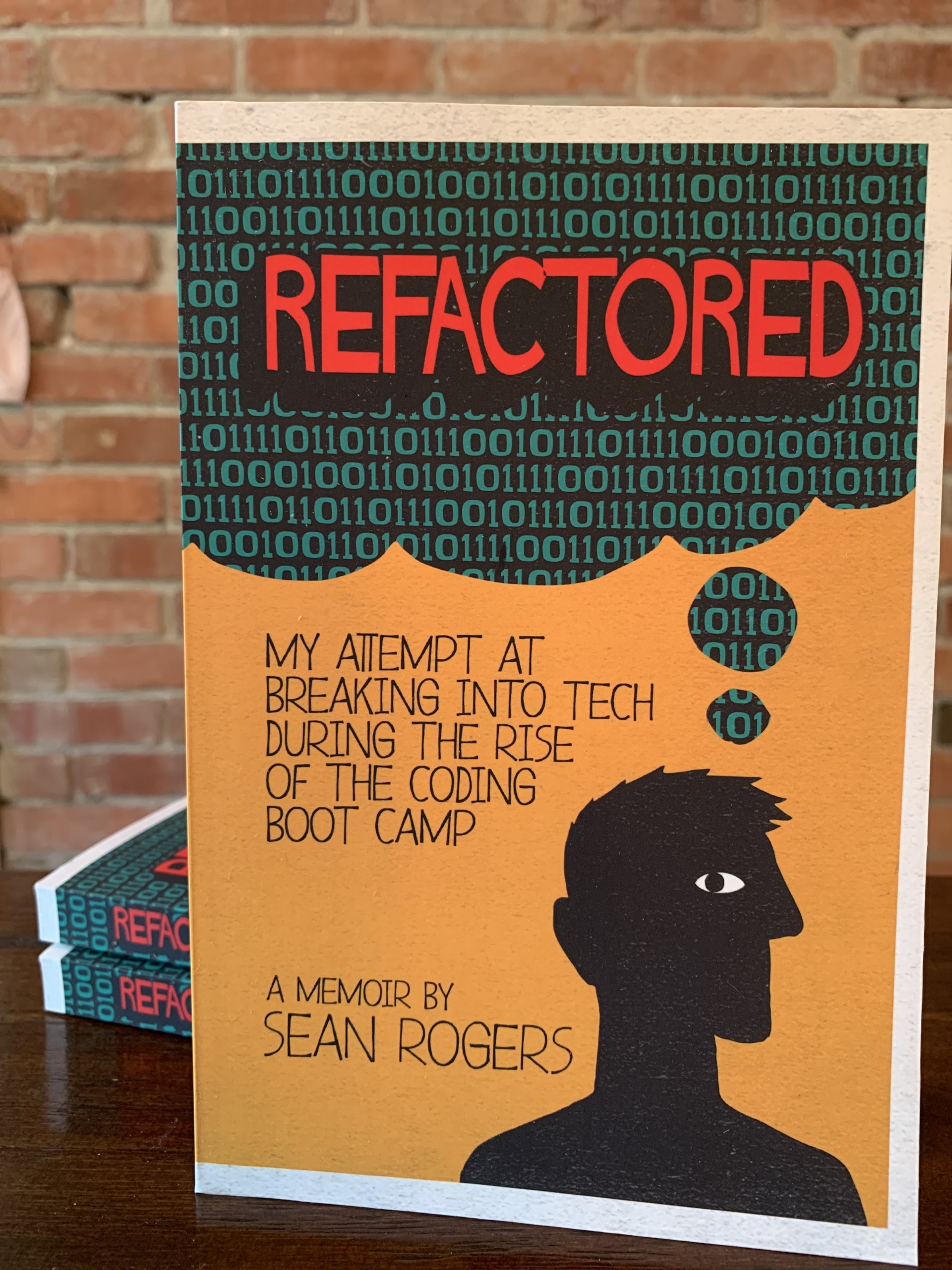
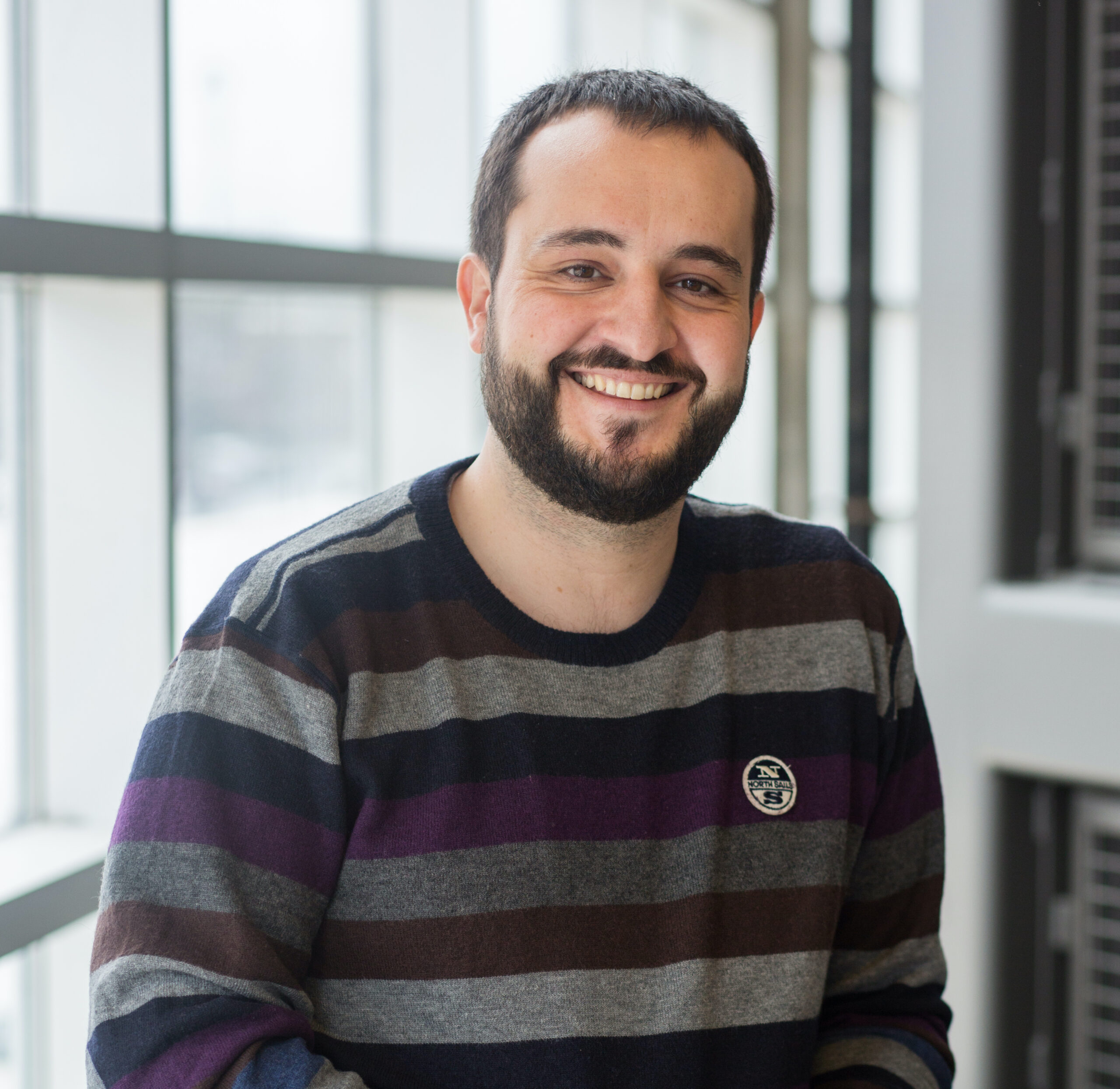
For someone who worked sixteen years at Barnes & Noble in countless roles, it would seem like a natural progression they’d end up publishing a book. But it was a life-changing, adventurous journey into the mysterious world of technology that led to Sean Rogers’ dream of publishing his first book, Refactored.

Sean’s tech journey began at the early age of… 39. In 2018 Barnes & Noble went through a process of massive layoffs, and Sean was one of the unfortunate casualties. Equipped with a Bachelor’s degree in English and sixteen years’ experience at a brick and mortar retailer, Sean decided to re-evaluate his career options. One day a Tech Elevator ad on NPR caught his imagination and he decided to sign up for its boot camp. A few months later he was coding at PNC.

“A lot of the people that go to these programs have a driving passion to be in software development, and honestly it hadn’t really occurred to me. I didn’t grow up wanting to be in tech. I needed a new trade, something to help me change careers. I was nervous, but I’m OK being nervous and being uncomfortable. In my mind it seemed more anxiety as part of an adventure rather than part of work. It seemed like a big thing to do, like to climb a mountain. Learning to code at 39 was just exciting.”

The path was not easy, but his career certainly changed. “It was very, very difficult, but it was a very positive experience. I made lifetime friends, teachers and staff were amazing, the pathway program was magic, four months later you have an entry level job with good wages and a career path that has a really high ceiling.”

We asked Justin Driscoll, Regional Director of Tech Elevator in Pittsburgh, to tell us a little more about it. “Tech Elevator is a 14-week coding boot camp designed for individuals that are looking to get into the software development industry through non-traditional ways. A lot of our students are career changers who come from all sorts of backgrounds.” Like Sean, many people feel stuck or unhappy with their careers, and Tech Elevator opens a door into a high-demand career path. The only requirement is a high school diploma. “Most students come to Tech Elevator earning an average of $30,000 a year… and the average starting salary of our graduates is $60,000.” Driscoll continues, “Sean was a fairly tech savvy individual, but had really strong behavioral skills. He has a liberal arts degree, worked in retail, strong behavioral skills, really good with words and writing, and he really took those skill sets and applied them to technology.”

Sean specialized in .NET class and got his first job at PNC a day before his code graduation day, at the Quality Engineering division. He started as an automated tester, embedded in an agile team, working side by side with developers and wrote automated tests for the front end and for the APIs. “I did that for one year and last summer I became test lead, so now I manage seven QE’s that do what I had done the previous year.” 

Refactored

Sean had written about ten fictional novels previously and always had a passion for writing. Somehow, Refactored, his first piece of nonfiction, is the first one to get published. What was the inspiring and motivational factor? “I always try to tell people who are thinking about going into tech to think of tech as a trade rather than tech as a passion that you have to have as a computer nerd since the age of five. You can do this as a job and it doesn’t have to be your complete personality. That’s something that a lot of people don’t realize. If you can be a good barista at Starbucks, you can probably triple your salary and learn to write automated tests or to do Javascript. I called the book Refactored, because that’s what I did with my life. Some might call it re-invention, but that’s not accurate. To refactor in programming means to take existing code and restructure it for improvements. That’s what the boot camp did for me: it took existing features and personality traits that I already possessed and made them more efficient, stronger, and valuable.”

We asked Sean to share a little about the book without the need for a spoiler alert. “There’s a lot of mini-biographies of the people I went there with, people who are very comfortable with risk, big personalities. Just from the amount of stress that’s happening in the class, there are some strange conversations and strange people, which I really enjoy. It was a fun journey and more memorable than my college experience. It being later in life, this is something I could do at 39 years of age and that there’s no way I could have done at the age of 18 or even 22.” 

Just over two years at PNC, a new career, a promotion and a book under his belt… Sean’s kept himself quite busy. But what does he do in his free time? “My favorite thing is the museums, the Frick, the Carnegie, the Warhol museum, the Mattress Factory, Pittsburgh is an art-centric town and I really enjoy that. I like the real effort that they take to include art as a central part of the city. I live in Dormont and I’m Dormont centric”, he confesses, “and I love to discover new restaurants in Potomac, which is sort of a secret place. A lot of people don’t know about it, a lot of restaurants, a movie theater, a bookstore, and I don’t think unless you’re in Dormont you’d discover Potomac.”

Sean’s story is nothing short of inspirational to those looking for a career-changing experience. If you want to hear the whole tale from the horse’s mouth, buy the book. You can drive to the Potomac bookstore, or it’s also available on Amazon. Then again, if you’re feeling a little more mischievous, you can also find it at BarnesandNoble.com

Nobel Thoughts on Pittsburgh

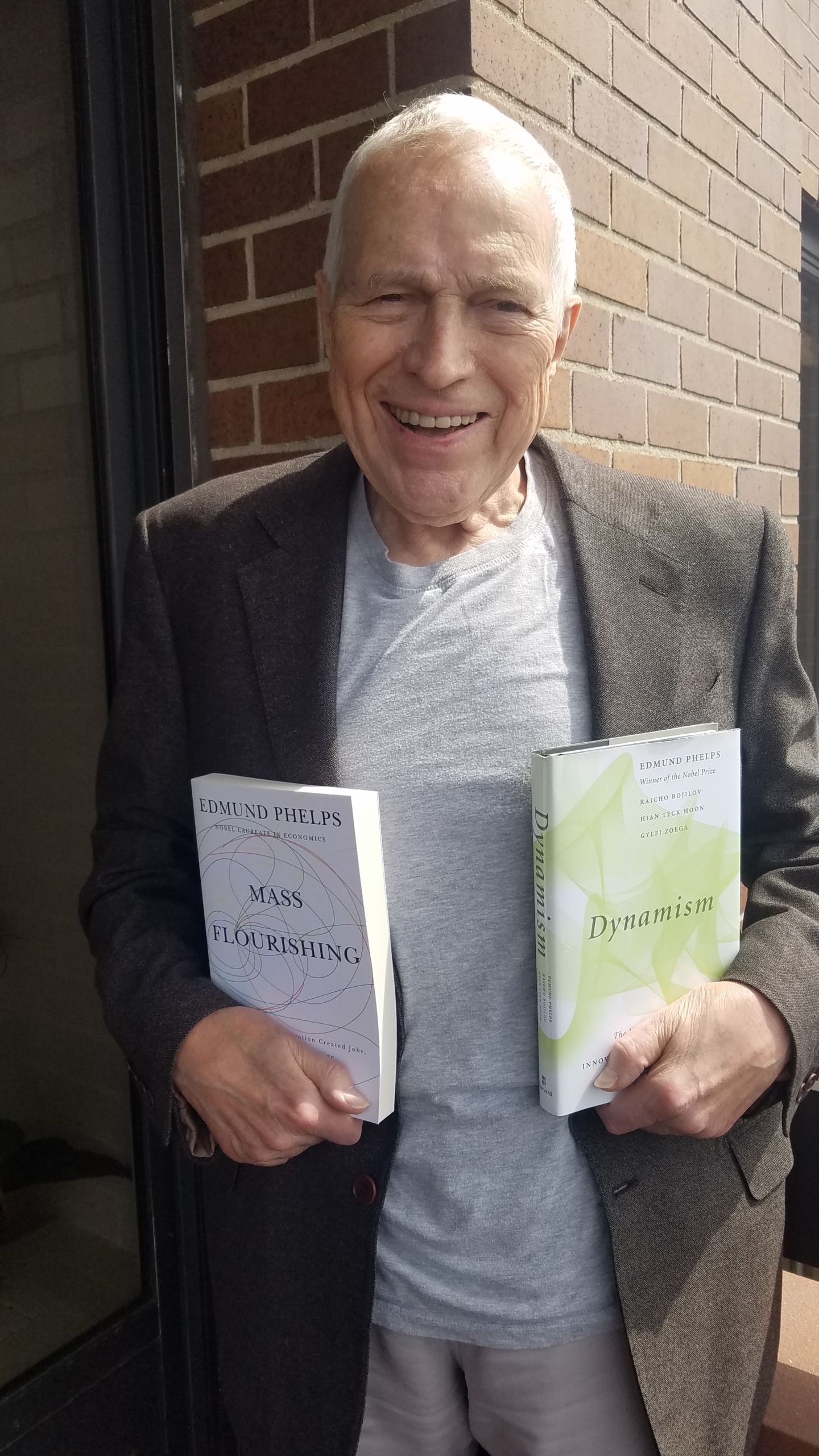
Edmund Phelps

Few Nobel Laureates have spent the amount of time and dug through so much research in the subject of innovation and dynamism as Edmund Phelps, who won the Nobel Prize in Economics in 2006. His current work focuses on the benefits of structural dynamism, creativity, entrepreneurship and the funding of these initiatives. So we talked to him to hear his thoughts on Pittsburgh’s innovative tech scene. 

Phelps’ latest book, Dynamism, published in 2020, is loaded with research showing strong correlations between modern values and innovation, with benefits that permeate throughout the entire economy. So what are these values and how does Pittsburgh stack up to them? Phelps’ research uncovers three key modern values that promote dynamism: individualism, vitalism and self-expression. That is what he likes to call “the right stuff.” Let us elaborate a bit… Individualism focuses on the inherently individualistic satisfactions of achieving, succeeding, flourishing and making a difference. Vitalism refers to people looking to challenge the status quo and looking for opportunities that make them feel alive. And self-expression is about being allowed and inspired to create a new thing in a new way, where a person has license to reveal a part of who he or she is. “One of the exciting things about innovating is the venture into the unknown. That’s so exciting and so much fun. You’re venturing into the unknown in the process of trying to create things,” Phelps comments enthusiastically.

One can easily argue that Pittsburgh checks all three boxes in both its innovative heritage and its current thriving tech scene. However, if we dig a bit into the fine print, individualism in Pittsburgh could be interpreted to be on the fence. Phelps contrasts values of community solidarity and staying in a circle of friends as traditional, anti-modern values that do not necessarily promote dynamism. So we asked him, in a highly collaborative culture like Pittsburgh’s, with a tight tech ecosystem, could this cultural trait hinder the city’s innovative spirit? “I’m glad you raise that question, but what I would say is that if Pittsburgh is doing well, and I see that it is, that is not evidence that every attribute of the people in the city is in the service of dynamism. There could be some attributes out there that are working in another direction. It could be that Pittsburgh could do yet a lot better if it had more individualism. But you haven’t killed individualism just by observing one causal influence when there are three or more causal influences at work.”

Edmund Phelps

Let us suppose Pittsburgh could do better, injecting more individualism into its culture – easier said than done in any culture – how do you breed the right stuff into a community? “To the extent that you could have more of it, the cultivation of the right stuff begins in school. School is a place where kids can be introduced to all sorts of aspects of life that they didn’t know existed. And also parents chatting with the children at the dinner table, the kids get to learn a little bit about what goes on in the business world and how parents get satisfaction from their work. And if you don’t have these things, it’s kind of tough. It’s one of the disadvantages that the disadvantaged have to bear, that they have been so cut off from what other kids have grown up with.”

We’re all too familiar with issues of inequity and lack of diversity, a top-of-mind item in the local tech community’s agenda. If the disadvantaged are not finding sufficient help in school or at home, how can the community rise to the occasion and embrace them? “I think that companies must make it a policy to give opportunities to the disadvantaged. Sure, a firm is not going to love everybody that comes through the door, but when it looks like there are grounds for hope, something about a kid that inspires confidence, then it’s important to give him or her the opportunity.”

Phelps puts a lot of weight into a culture of creativity and approaching work not as a chore but as a vehicle to release one’s creativity, which he sustains has lost steam in America’s post-innovative boom. “All the instruments of society could be enlisted to teach people the importance of work. Work is its own reward and it gives people a chance to exercise their creativity; we all have it, you know? And to build up self esteem. And you can’t just let the schools handle it. It’s also the job of the government and quasi-public entities. But there’s so much talk these days about dynamism as if it was residing in some institutions or economic policies or in science. There’s not enough recognition that dynamism comes from the people. The reason why America was so prosperous for so many years, more than a hundred years I would say, is because people possessed a lot of dynamism. They acquired that dynamism by having the right values. Dynamism is essential, there’s no substitute for it. Without the dynamism, forget about it.”

But dynamism also needs funding and we’ve heard many Pittsburgh entrepreneurs call out the shortage of venture capital making its way into local startups. “It is important to set up institutions and hubs where companies can feed into and share information to finance startups, and I think it’s one way in which access to capital can be improved. The main effort ought to be to fuel the innovation that will bring increased incomes to the communities. These hubs are very important.”

Assuming the right values and the right funding, say all the right stuff, dynamism is perceived by many as a threat. Advancements in robotics and AI are paving an accelerated path to automation, threatening wages and jobs. Phelps’ book recognizes two types of robotics – additive and multiplicative. Additive robots can perform the same tasks as a human and therefore act as a substitute for a human worker. But advances in artificial intelligence and machine learning have given way to multiplicative robots, which augment the power of labor. When multiplicative robots are introduced they have a negative impact on wages in the short term, but in the long term they make each worker’s productivity higher, thus increasing wages. 

“Robotics will at first displace labor, but in the long run it increases the productivity of labor so to some extent that may also be true of new kinds of robotic technology coming out. It will be two-sided, it will have some benefits as well as short term harm, but we’re a long way away from understanding where the long term effect of robotics will be.”

In a previous interview, Phelps claimed that “the machines can’t produce the new ideas that Hayek and Keynes and Samuelson had” in economics. With developments in AI, vertiginous processing speed and access to monstrous amounts of data, robots are learning to perform highly creative and intellectual tasks like writing a piece for chamber music or performing surgery. Can robots develop economic solutions as well or better than human economists? Phelps’ view is not dismissive, but hesitant. “I can see that some robots may prove to be successful at creating. I know it’s a kind of a hard notion to get over, but it’s hard for me to think that a robot is born with creativity. Robots may be designed in such a way that if they are confronted with a new environment, they will react in new and unexpected ways and it may look like creativity.”

And when robots or AI get creative, who makes the call about the ethical decisions of their creative solutions? “Industry has to some extent already established panels to set up standards and provide advice to users and developers. We need to acknowledge that the indiscriminate use of robots could be dangerous to some subset of people. But throughout history new things have sometimes been dangerous, and society got on top of it and took steps to protect people from some of the harms of some new methods of production. We’re already seeing the emergence of bodies looking into the ethics of robots. I would start at the industry level and see whether they can set up their own bodies to protect people. They can see that it is in their best self interest to do that.”

We asked Professor Phelps to share a fun Pittsburgh anecdote with us. While he came many years ago to deliver a speech at Carnegie Mellon University, he recalls a more random and accidental experience. “Once I was on a plane from Los Angeles to New York and we had dark winds, snow and everything and it had to land in Pittsburgh. So there was a planeload of people on this bitterly cold, damp night, all standing there in a corridor, nobody talking to anybody. And I looked across and there was Marlene Dietrich. So there’s a Pittsburgh story for you.”

A devoted classical music aficionado, Phelps played trumpet in his high school band’s brass section. So we had to ask him if he’d ever seen the Pittsburgh Symphony Orchestra in concert. “I missed it! Many years ago I just left London and they played at the Royal Albert Hall and everybody wanted tickets to that, and there it was, the Pittsburgh Symphony Orchestra. Did I see it? No, I was on my way back home. But I did read the reviews and I was so envious because the reviews said how fantastic the brass section was. So I hope you can bring it back so I can see the brass section. Send them my way please.” 

We’ll try to convince Mr. Manfred Honeck to pay a visit to Carnegie Hall for Phelps to see Pittsburgh’s awesome brass section. In the meantime, better yet, we extended an invitation to Phelps to see it at “home,” and by the way see first hand all the cool innovation and dynamism coming out of here.


Road Warrior

Ryan Green and Brian Finamore

If you’ve ever taken an Uber ride, you surely heard some stories akin to the stuff or urban legend. You hop into the ride with a total stranger, strike a conversation and by the time you hop off you have the coolest anecdote to share at the dinner table. It may seem fun to hear these from the comfort of the back seat, but a lot of blood sweat and tears are invested by the six million ride-hail and delivery drivers getting us home from a bar, bringing us pizza or delivering our groceries. 

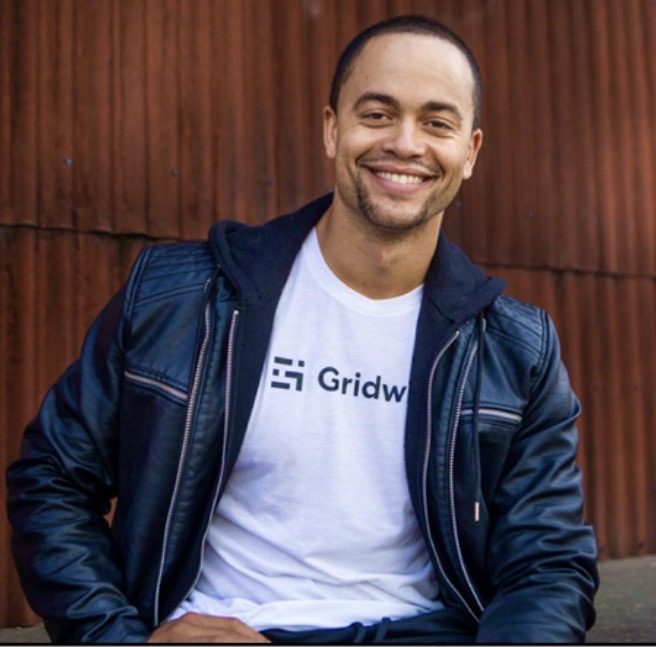
One man had a vision to help these road warriors with an app that would empower them with the tools to plan, manage and analyze their operations to maximize revenues. His name is Ryan Green, co-founder and CEO of Gridwise. Ryan should know a thing or two about mobility, as he’s lived in twelve states before landing in Pittsburgh. But more importantly, he was a road warrior himself. “When I was an active duty Naval Officer I was playing around with some ideas. I was living in Pensacola and this new concept came into our city called Uber. I was really intrigued by the model so I started driving for Uber to make some extra money and gain perspective of the new platform.” 

A US veteran, Ryan moved to Pittsburgh after leaving the military for a trading job at PNC. But in the back of his mind he had 25 startup ideas up his sleeve with the goal of having a fully validated new venture by year one and actually launched by the end of year three. One of those ideas was Gridwise. “I was taking rides with Uber and Lyft and hearing drivers complain about the same pain points that we all experienced and the light bulb lit up! So I put together a landing page of what I thought Gridwise could be, aggregating all the important data to help drivers make better operating decisions and make more money.”  He put it online and pushed it to Facebook groups across the US without an actual product. He had 500 people sign up for free in a week and over 100 insightful questionnaires where drivers “spilled their guts about their pain points, proposed solutions, etc. At that point I thought I was really on to something there.” In a networking event he met co-founder and CTO Brian Finamore, then at YinzCam, joined forces, pitched AlphaLab and got them to invest. “That was the catalyst that enabled us both to leave our jobs and start Gridwise. That all happened in year one, a lot faster than the three years I had projected.”

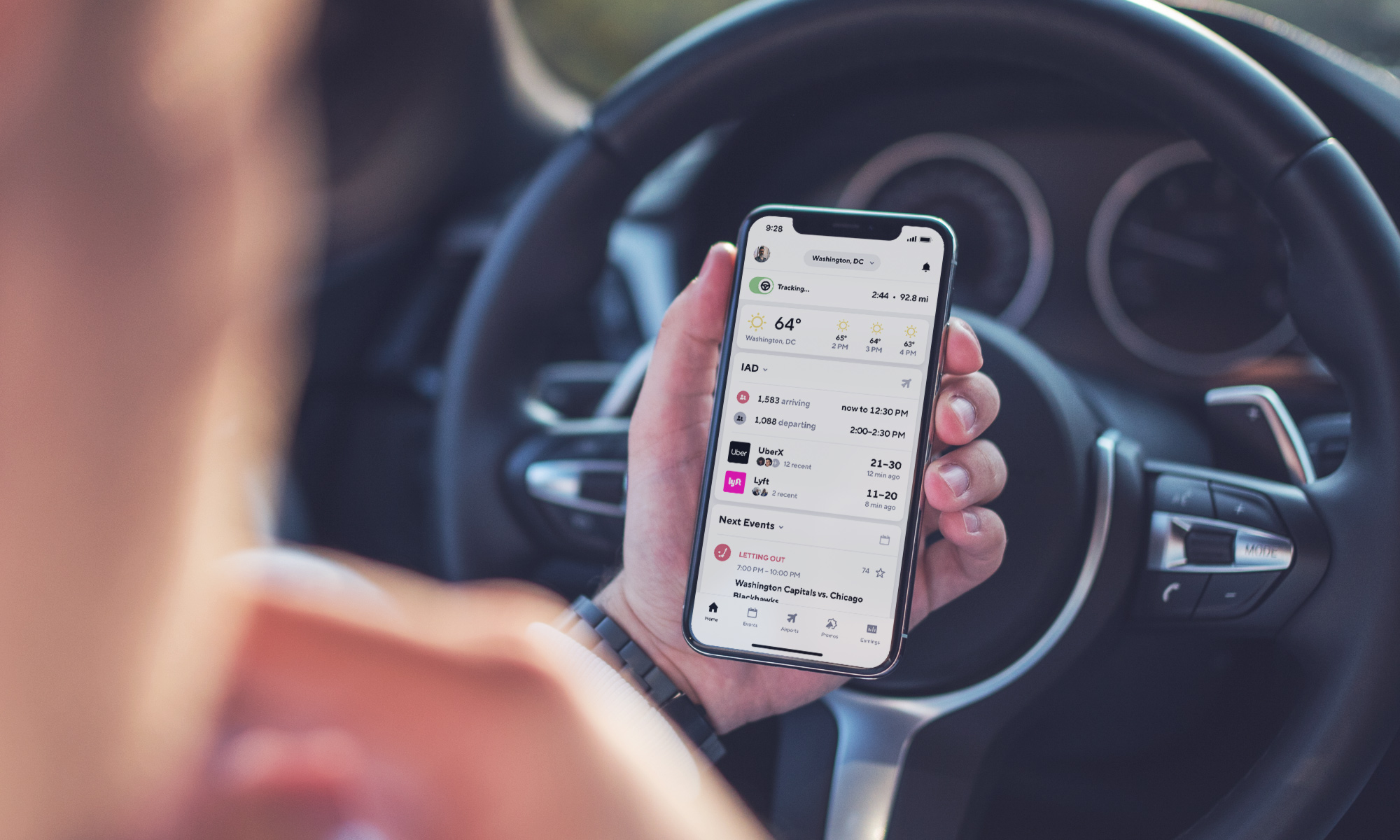
Gridwise App

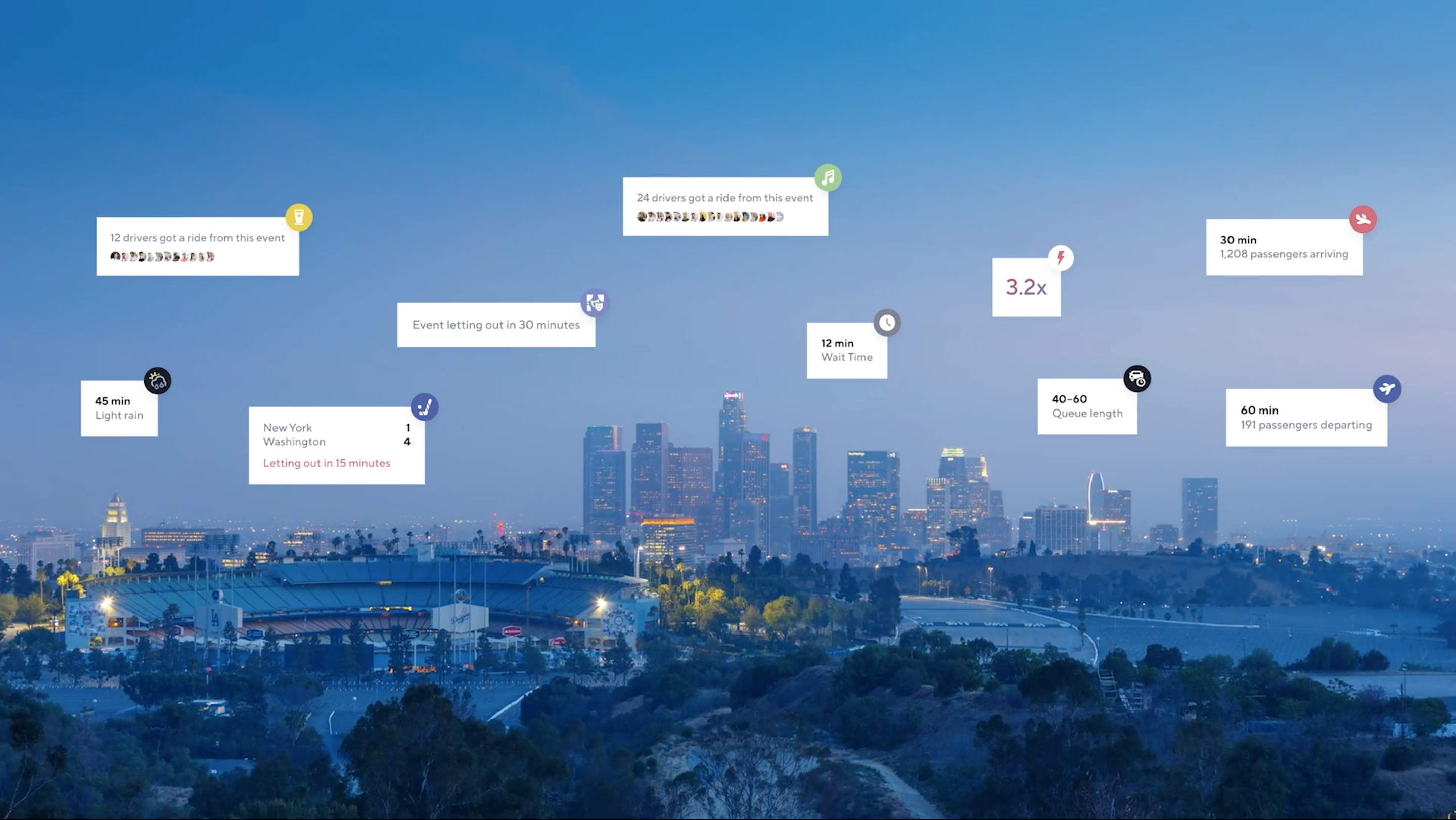
Today Gridwise is a utility for gig drivers across the entire driver journey, no pun intended. Before the ride, it is a planning tool to help them plan the next few hours or next few days to maximize their revenues. As they hit the road it provides them with real-time contextual data like alerts of events or airport passenger traffic which help them make real-time decisions. And after they park, it provides the insights and analytics on their performance to compare themselves to other drivers or previous periods. As drivers are turning apps on and off to do one type of delivery or another their data is completely fragmented across all the services they are driving for; Gridwise aggregates and provides data for all the services they are using, currently supporting 25 services providers. 

We asked industry pundit and influencer The Rideshare Guy what the biggest pain point for drivers is. “Right now, it’s earnings! Drivers are hesitant to get on the road for low pay, especially during the pandemic. However, companies are announcing new bonuses to bring them back. It’s a delicate balancing act, but in general, gig workers would like to see more money/higher earnings.” And this is Gridwise’s sweet spot – helping drivers make more money. The Rideshare Guy continues “Gridwise is actually one of our favorite mileage tracking apps – it’s free, which is a big plus for rideshare and gig workers. In addition to tracking mileage, it also links with Uber, Lyft, Doordash, and other major services to provide localized event, airport and other demand information, making it a step above the rest.”

So how do they monetize the platform? The business model is dual. “B2C revenue comes through a premium version of the free app with deeper analytics and an ad-free experience plus a marketplace of value added white-labeled services like Gridwise Protection or Gridwise Gas. B2B revenue comes from advertising and sponsorships from companies like Google, AAA, Bosch or Synchrony Bank. Plus we recently launched Gridwise Analytics, the only platform that can provide ground-truth insights into how people and goods are moving across ride hail and delivery services, shedding light on the supply and demand patterns across the different service providers and helping answer key operational questions that stakeholders may have in the mobility space, real estate, retail, financial services, and a multitude of services.”


City Landscape with Events

And where does all that data come from? “The data sources come from a multitude of third-party sources, but the other source is drivers themselves. Location data, ride-hail or delivery, earnings from different service providers, etc. But what’s unique to us is the combined data the platform obtains and the insights it is able to share back to the drivers.”

The platform is currently fully supported in 80 metropolitan areas in the US plus there is a limited version open nationwide. It has empowered over 200,000 drivers in the last year, aggregated more than 40 million trips, revenue is growing at 24% per month and is approaching the billion mark on driver miles tracked. Pretty impressive for a team of 16, but plenty of room to grow with 6 million gig drivers in the US expected to hit 11 million by 2025. 

Ryan’s vision is “to become the hub of gig mobility solutions. Where we are empowering the workers that are moving us and our goods between point A and point B. We are the go-to source for analytics in this space. And we are the lead provider of last-mile fleet solutions with a large network of gig drivers. As we build out an even larger network of gig drivers, we open up that network to existing service providers and retail and restaurant groups, and last mile providers who are looking to tap into our driver network. This feeds jobs into our system and enables us all to work together in building a more efficient and seamless mobility ecosystem as we become the repository of our supply activity in the space.”

Interestingly, Gridwise was born in the hub of autonomous vehicles, self-driving cars, trucks, drones, helicopters, you name it. How will this affect the gig economy or Gridwise’s platform and business model? Ryan feels confident that “autonomous vehicles are not a threat, but an opportunity. They are leveraging Gridwise for analytics related to gig mobility, to enhance go-to-market strategy. In fleet solutions, it’s inevitable that these vehicles are going to be a part of this ecosystem, so we’ll continue to empower workers, but we’ll start to bring autonomous vehicles into our networks. So when the jobs come into Gridwise, those are going to be fed out to human drivers or to autonomous vehicles based on the types of jobs they are.” And which jobs could be more appropriate for human drivers? The Rideshare Guy offers a few examples like “locating your intoxicated passenger at the end of a pro sporting event.” It may take a lot of AI to figure that one out.


Ryan Green CEO Gridwise


Pittsburgh’s been kind to Ryan, among other things allowing him to deliver a three year plan in year one, and he attributes much of that to the ease and value of networking in a smaller town with the opportunity to make a bigger impact in the tech ecosystem. But he does see a shortcoming in the access to capital. “There is a lot of capital in Pittsburgh, but I’d like to see it invested in more ways. I am a little biased towards the tech ecosystem, where we’re seeing so many companies fail or having to sell because they don’t have the financial resources to accelerate their businesses more.”

On a personal note, he appreciates a “small city with a big city feel. You get the sky scrappers, the restaurants, but the city is relatively small and you get a lot out of it. It’s also very easy to get around and very bike friendly.” It turns biking is his primary mode of transportation, coming from a guy running a company serving drivers. And while he apologizes for almost coming through as a party animal, he would appreciate “a better night life for people that are over 30 years old, more and better lounges with modern music. Also the wonky hours from restaurants and businesses, some of them are closed on Mondays, some of them are closed on Tuesdays, sometimes I want to get a cocktail and then Cinderland’s closes at 11 pm. And I’m just getting started here!” he comments breaking into laughter.

While many of us get a kick out of finding holes in the wall around town, he’s made a hobby of it. “One evening a friend and I were looking for a restaurant in a residential area in East Liberty and called out to some ladies sitting on their front porch and asked them if they knew about the Jamaican restaurant Mama Rose and she waves at me ‘It’s right here honey, come to the back of the house,’” he voices in his best Caribbean accent. “Hopefully I don’t get her in trouble by overly promoting her here.” Well the little hole in the wall is likely already on its way to GrubHub, UberEats, DoorDash and eventually, Gridwise. 


See career opportunities at Gridwise >>

The Fishmonger of Pittsburgh

Henry Dewey

If you’ve seen the 70’s blockbuster, Jaws, you’ll surely remember Quint, the badass, no-nonsense fisherman who brought order to a chaotic room full of reporters and politicians with the screeching sound of his nails against the blackboard. In Pittsburgh we have our own sort of Quint. Henry Dewey’s rawness, authenticity and love of fishing remind us of Quint, but what’s most badass about him is the quality of his fish and the pride and artistry he puts into cutting it.

A fishmonger, if you’ve ever seen one, Henry is the co-owner of the Penn Avenue Fish Co. When you go there, you’ll see him surrounded by hundreds of pounds of tuna, halibut, salmon or sea bass where he and his crew are cutting and slicing 80-pound fish with the craft and delicacy of an origami paper cutter.

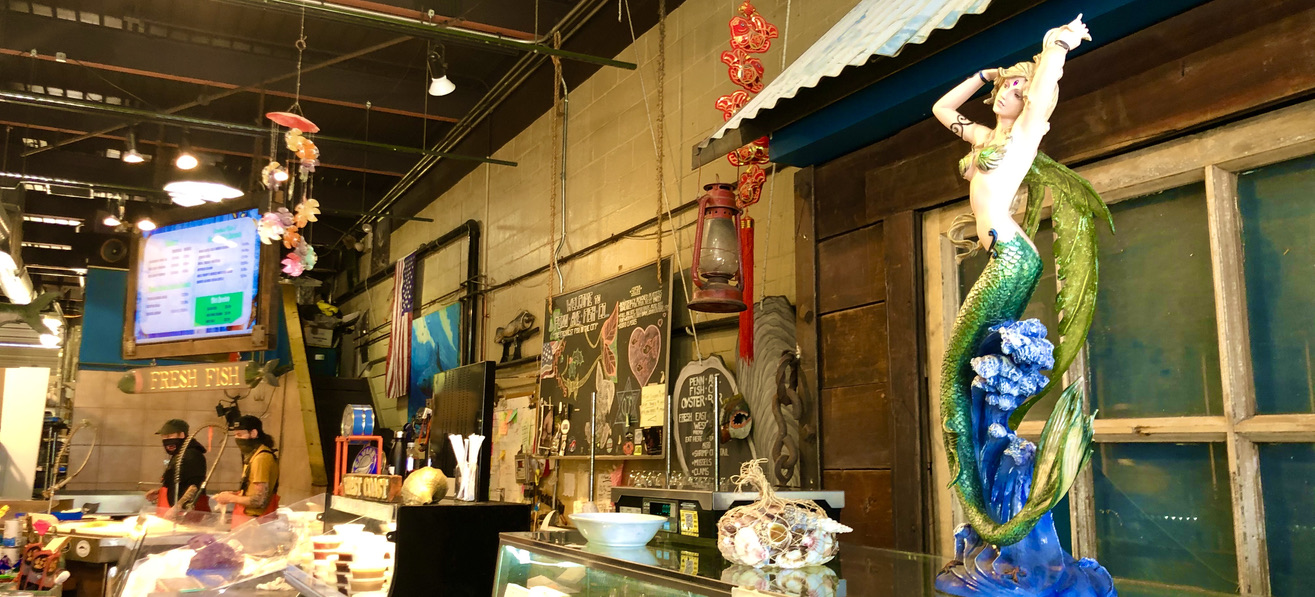
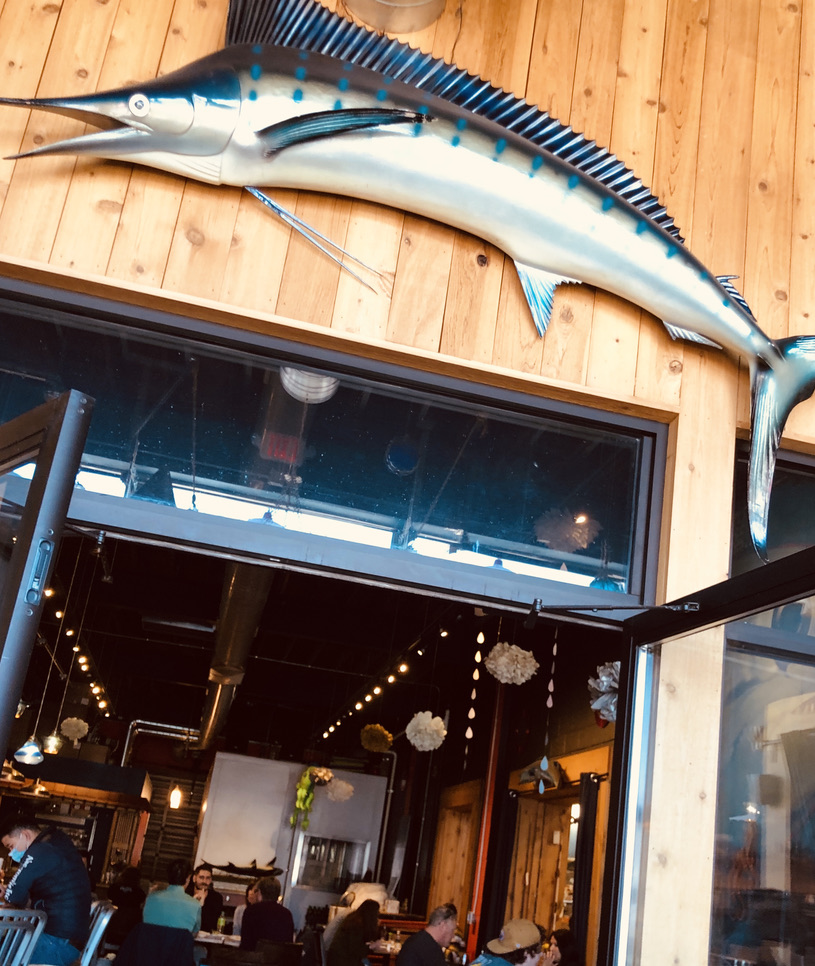
Penn Avenue Fish Co. has a lot of fans in the tech community and is a must-stop in a Strip District shopping spree. You enter the space and feel like you just got off a pirate ship somewhere in Florida and walked into the local fish joint. A huge marlin, marine murals, a pink flamingo, and a mermaid statue decorate the place inhabited by fishmongers in trade apparel who look like they just got off the boat with the catch of the day. Enough to make Jack Sparrow feel right at home. “I’m a Florida boy,” explains Henry, “so I try to make my place like Florida style, when you walk in I want you to feel like you’re in Florida.” 

Penn Avenue Fish Co. Mermaid

As you wander through the space past the oyster shucking area, the seafood gumbos, the octopuses and make it to the fish section you immediately realize you’re in no ordinary fish store. On to the left is the restaurant and sushi bar, who many consider the best in town. Sure you’ll find the staples: tuna, swordfish, salmon, but Henry goes beyond into black cod or turbot. “People that know what they’re cooking, know what they’re eating. We always try to have one or two or three items that are super exciting that people never had. We had 20 pounds of John Dory in the house today and it’s completely gone. You just have to keep it exciting.”

We’ve found excitement at New York’s Citarella or the fish markets in Madrid and Barcelona, but they’re no match for the combined quality, variety and artistry you see here. “The strongest cog in the operation is building relationships with the best purveyors and paying your bills on time so when I want a number one tuna they give it to me.” Then you have to move the inventory fast, as the fish doesn’t get any younger. “ It’s like riding a bike, it’s easy to ride a bike fast but it’s really hard to ride a bike slow; you’ll be shooting flies away from the fish all day long.”

The final touch is the treatment of the raw material to put restaurant grade fish in your kitchen, and this is where the fishmongers come in. “We have this thing that when we cut a fish we try and have that be the best fish that we’ve ever cut. It’s a constant improvement. We all cut fish the same way, the way that I cut it. If some guy gets abducted by an alien and he’s in the middle of cutting fish, someone else can step in and finish it and know exactly where the other guy left off. There’s different styles of fish, like the salmon, trout, arctic char, you cut them all the same, all of their skeletal structures are the same. The young guys are really eager and they love learning how to cut fish.” 


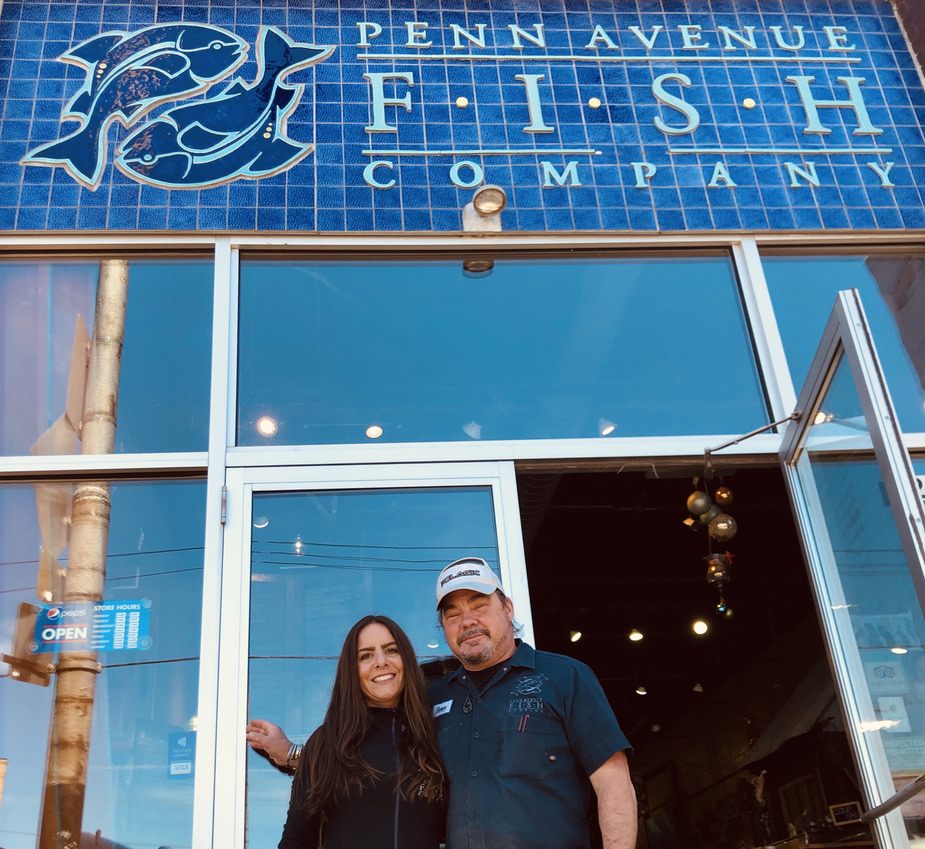
Angela Earley and Henry Dewey

Henry carved his teeth in the restaurant industry, starting as a dishwasher, moving on to cook, and eventually executive chef. Along the journey an innovative chef advised him to “worry about all your technique and knowledge before you worry about money as that will eventually come.” So he kept perfecting his craft and found a job at Benkovitz Seafood until the day it closed. As serendipity would have it, while doing some internal brainstorming on opening up his own fish market, he ran into his friend Angela Earley, a pescatarian who had just graduated from college and was tinkering with the very same idea. They had met years earlier at the Déjà Vu lounge, where Angela was managing the bar and Henry running the sushi bar and built a strong relationship thereafter. “Angela does everything I can’t do and I do everything she can’t do, I always try to find someone that is the opposite of me and that seems to be a good recipe for a successful partnership.”

Pittsburgh has turned into a foodie’s playground in the past decade and Henry certainly played a role in the seafood department. “I feel like I’m a little bit part of that because if I wasn’t here and people want to make miso-glazed black cod they’d have a hard time even finding it. So many people come here and they do restaurant quality stuff at home. If you take that piece of tuna home you won’t have to do anything to it and it’ll be as good or better than restaurant quality.”


So what’s in store for the Penn Avenue Fish Co. in the new normal? “The pandemic caught us by surprise. I remember that Sunday I didn’t know what to do and we didn’t order any fish and we got completely wiped out. Everyone just came in and bought every piece of fish they could. It’s been head-spinning busy. We build a great level of trust with our customers so they’d give us their credit cards and we just bring it out to their car. Right now the dust is starting to settle and we’ll bring the oyster happy hour back. We strived to do the highest quality possible and the customers really appreciate that. We have the nicest customers ever, they bring us baked goods and if they see us out at a restaurant they’ll buy us drinks.”

In his free time, you’re unlikely to find Henry at a bar, not his thing. Instead, he’s probably playing guitar and bass with a local garage band. When in the kitchen, he enjoys his favorite fish. “My number one favorite fish is the French turbot. You can go pretty fancy with it, it’s like a nice firm Halibut with a metallic ocean flavor that’s very French.” 

Henry calls himself a Florida boy with a retro attitude. He has no time to waste on social media and his use of technology is limited to a tablet, an iPhone and a delivery account with Ritual.co. His raw, no-nonsense style seems both contrasting and complementary with the pride, care and artistry he puts into his work. But don’t let that softness fool you, if he met Jaws at mid sea he’d have him for breakfast.  

A Love for Robotics

Tom Galluzzo

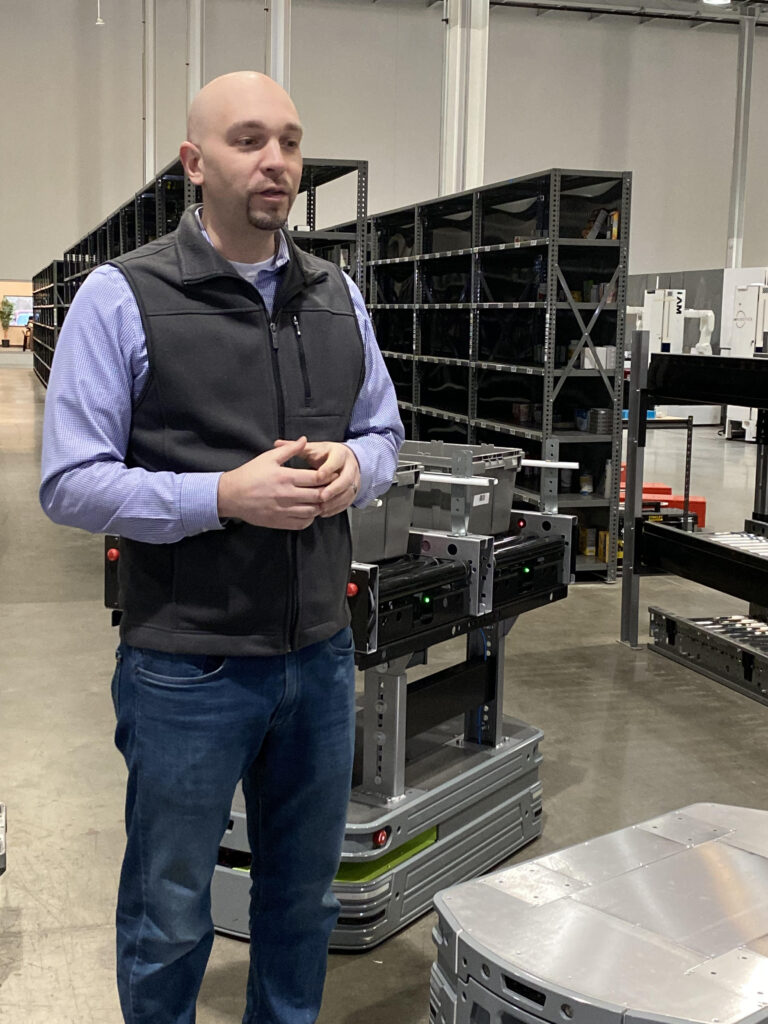
It all started as a work of love. A love for robotics. As if patiently teaching your toddler how to pick up round pegs and fit them into round holes, Tom Galluzzo, founder and CEO of IAM Robotics, found himself at Carnegie Mellon’s famed National Robotics Engineering Center teaching robots with arms, hands and eyes to look for and find objects, pick them up and move them from point A to point B. All of this autonomously, without adult supervision.

While at NREC, Tom was working alongside some 150 robotics research engineers in the aforementioned project for DARPA (Defense Advanced Research Project Agency) who do all the research for the DoD. “We worked there for three or four years and got a lot of confidence in our progress. We figured there’s gotta be some low hanging fruit in industry where autonomous manipulation can be really interesting technology and have applications for some industry problems.” And it would be an Amazon acquisition that would give him the final push. Around 2012 they bought out a company called Kiva Systems (now Amazon Robotics), a warehouse robotics company for almost $800 million. “Wow, this was huge in robotics! So we started looking into ecommerce and warehousing and talking with warehousing operators and fulfillment centers and CEOs of logistics companies. They said ‘if you guys can build a robot that could drive around my warehouse and find objects and pick them up and collect them to get ready for shipping, that would be a no-brainer for us because that’s a huge labor sink. We can’t find enough people to do that kind of work, especially on the third shift.’”

This was the Eureka moment for the business opportunity. “Having a robot that could do that would be really amazing. We looked at some business cases, we looked at costs, what the robot would need to do, and we started pitching some folks in 2013. We approached Innovation Works, one of the local seed organizations, and they gave us some funding. It took six months of pitching but we eventually proved to them that we had enough of a business case and interest from the market and they gave us funding to build a prototype robot. So we did, and that was the start of IAM Robotics.”

Bolt Robot

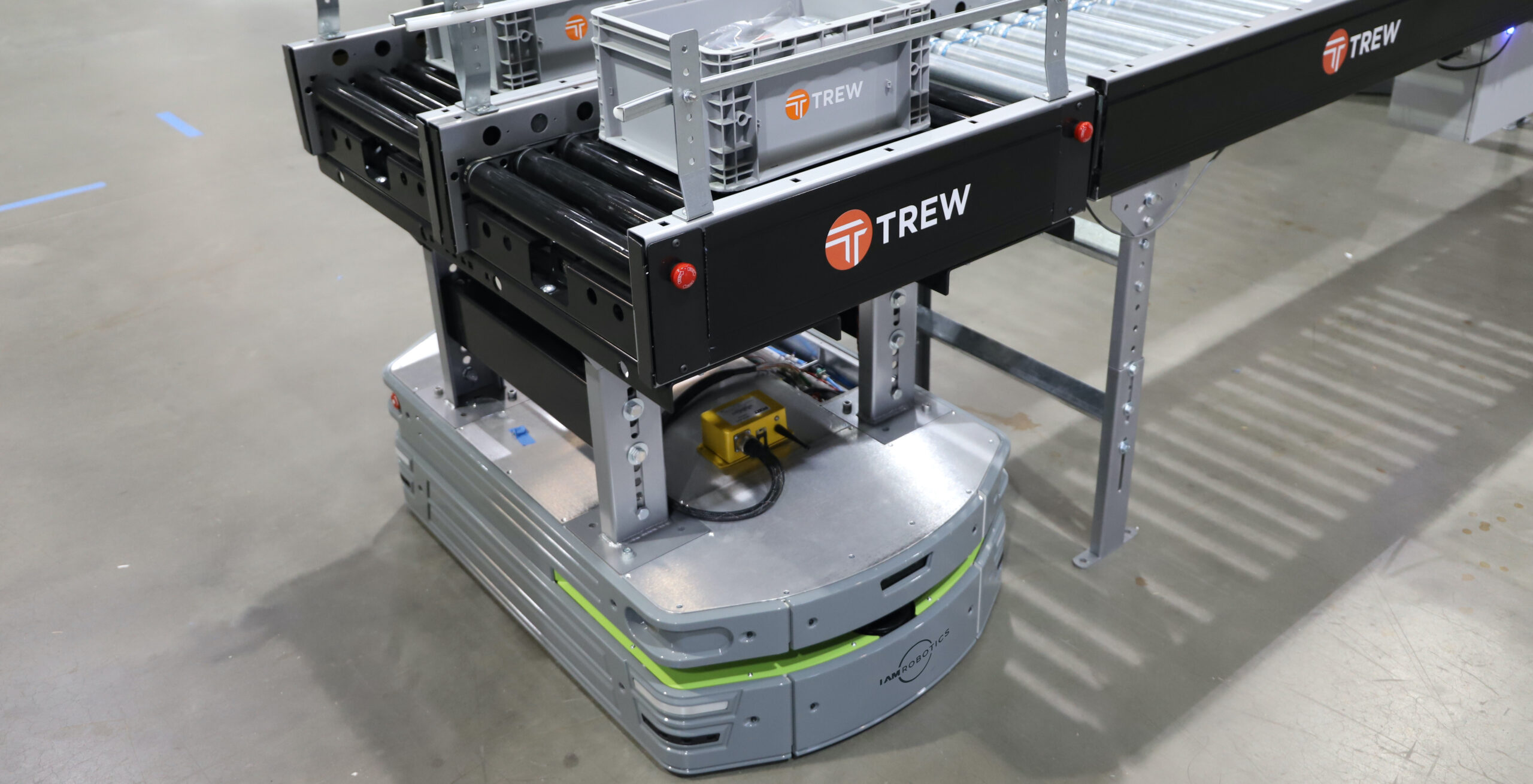
The robotics market is still relatively young. Market size estimates vary widely in the tens of billion dollars depending on the source as do growth projections in the double-digit CAGR range, but what is clear is that it has gotten big and will be getting a lot bigger. IAM Robotics is in the materials handling segment, one of the fastest growing areas. These machines often replace older equipment like static conveyor belts with the benefit of mobility, flexibility and lower costs. “For a lot of the work we’re doing right now, robots are not doing the work of people, they’re doing the work of conveyor systems. Customers are looking to augment their conveyor systems to have more flexible operations. They don’t want to install this big conveyor in the warehouse and that’s why they come to us; they’re looking for mobile robots that can replace that conveyor so they can have more open floor space and lower maintenance and installation costs. Rarely do we see a case where a company is going to take a purely manual moving process and augment it with robots, it’s more about looking to replace their existing conveyor lines or building a new facility and they need to move objects from point A to point B on a regular basis. And sometimes they don’t want to have to do it with people so they look at robots to be able to transport the goods.”

Tom and Co. are busy with new game-changing products and strategic partnerships; this week they introduced their new flagship product, Bolt, an autonomous mobile robot that offers unparalleled flexibility, safety and power designed to retrofit custom tops and equipped with 360 vision and high-power swap batteries. And in late March the company announced a partnership with Tompkins Robotics in an effort to deliver human-free automated sortation. Standard sortation systems require humans to sort items, this new xChange system completely automates the order fulfillment exit process reducing costs and labor requirements.

There are a lot of competitors in this market, about fifty mobile robot companies worldwide, and they’re all gaining traction because there’s a huge number of incumbent warehouse automation companies that are used to selling conveyor or fixed robot arms and they have no experience or skills set in autonomous robots. So they’re relying on the new technology from startups to be able to help provide customers with the flexibility and the solutions that the robots are bringing to market. “Customers are just dying to get their hands on autonomous robots because of their flexibility, because they can’t find enough people, because it offers a quicker solution to automate them than conveyor systems.”


Kraftwerk Lyrics

Today IAM Robotics employs 70 people and is expected to hire another 30 by year end. An internship program brings a lot of strong, smart engineers from CMU and other schools across the country to feed a pipeline of future hires. Tom feels fortunate about the talent pool in town across disciplines and is pleased to see that progress is being made in bringing commercialization talent away from New York and Silicon Valley. “The capital influx in town has helped with the big bucks coming into the driverless car companies and they’re able to recruit some real commercial talent.”

Tom was born and raised in Buffalo, NY, moved to Florida to attend college and grad school and landed his first robotics job at Harris in that state. There he joined a number of industry groups, where he met his wife, who was working at the Penn State Electro Optics Center. “We met and eventually got married and we wanted to have kids and be closer to family. I’m in robotics and Carnegie Mellon and Pittsburgh had been reinventing themselves in the world of robotics, so I thought there’s tons of great opportunities in robotics in Pittsburgh.” He reached out to some friends at CMU and eventually got the job at NREC “an amazing and unbelievable place to work. I learned so much from so many talented people. And that’s how I ended up in Pittsburgh; my wife’s from the area, we got married and it really allowed me to continue to grow my career in robotics.”


Tom Galluzzo Bolt Robot


But there’s a big leap between growing your career in robotics in Pittsburgh and launching your own company here. “The pluses are very clear: great quality of life, great accessibility to talent and resources, easy to get around geographically, cost is reasonable, salaries are reasonable. From all those perspectives, very good and second to none! I would say we’ve done a lot better on access to seed capital in town, but there’s just no comparison for Pittsburgh to, say Silicon Valley or Boston. On the positive front I’ve seen certain investors that have strategically decided that they’re going to focus more on Pittsburgh because of those factors and it’s less competitive to find deals, but that’s still a minority.”

On a personal front, Tom loves the secret treasures this city keeps surprising us with. “There are so many hidden gems in this town and you’re always discovering something new. Some new place to eat, some new park, some new place to shop that you’ve never heard of before. Everyone seems to know about it but it took me like a year and a half,” he laughs. “It would be great to know about those things faster in a centralized place.” And what is his favorite hidden gem? “My wife and I love sushi and we’ve searched around for many years for the best sushi restaurant in Pittsburgh, and by far I have to say that Slippery Mermaid in Sewickley is amazing. They fly the fish fresh every week and the quality was really high, we were impressed. If you’re a sushi fan there’s actually really good sushi in Pittsburgh at Slippery Mermaid.” Nuff said, we’re adding it to our Pitt Stops.

Upon concluding our conversation, we couldn’t help but ask Tom, a Buffalo native who started a new life in town, is he a Bills fan or a Steelers fan? “I share my time between the Bills and the Steelers, I’m very happy for the Bills when they win and I’m happy for the Steelers when they win. And if they play each other I’m like meh… whatever.”


See career opportunities at IAM Robotics >>

Singularly Transformative

Tech Consulting

A Spaniard, a Mexican and a Brazilian Walk Into a Bank. The branch manager asks “Habla English?” They answer “Yes, habla English, Java, Scala, Ruby, Swift, C#, Agile, Python, PHP...” 

Transformative technologies have become one of the most popular buzzwords in recent years, but in Pittsburgh, they are about as germane as french fries on a salad. Most of them come out of highly specialized startups in robotics, AI, machine learning or natural language processing, but have not quite been the domain of the big five consulting firms or their clients. It is only fitting, then, that when Sngular, a foreign, nimble, specialized transformational tech consultancy sets up shop in the U.S., it happens to land in Pittsburgh.

It wasn’t by design, but born out of client demand and referrals that this Spain-founded international company opened its doors downtown. About four years ago, Daniel González Rico, Head of Talent & Culture, was tasked with an ambitious pitch for a Pittsburgh-based financial client. The client asked for a proposal, he and the CTO (now CEO) got to work and… be careful what you wish for! They won the process and had to scramble to hire a team of 20 specialized techies in 20 business days. We talked to Daniel and two of his colleagues, Scrum Master Gabriela Arriaga and People Manager Aline McAdams to hear the story of how this tech firm set up shop and expanded in Pittsburgh.

Upon winning the bank’s project, Daniel recalls “we weren’t expecting things to move that fast, but we started hiring local people in Pittsburgh, and we brought in talent from our offices in the US, Spain and Mexico. A lot of talent abroad want to come to the U.S., but there is only one thing that can be a detriment to move to Pittsburgh: the weather,” he comments with a chuckle. He had to play tourist guide for a bit, taking foreign candidates to Mt. Washington, shooting pictures around town and eating pierogies. “People started saying Pittsburgh was like a smaller version of New York, with a beautiful skyline, great food and great people. They were getting excited about news of the new Pittsburgh gig and it was very well received in our offices around the world.” 

Daniel Gonzalez

Sngular was founded in Spain with offices in Europe, the Americas and Asia/Pacific. They deliver innovative, custom tech solutions to clients in finance, healthcare, retail, telco and other industries. Their value proposition is bringing last-generation solutions with specialized skills that often clients cannot staff internally fast enough. “Our business analysts are not just business people, they have a comprehensive knowledge of the latest technologies and the business acumen, which is not very common,” comments Daniel. 

Gabriela, a cybernetic engineer, points out that most of their projects consist of back-end as well as front-end development projects, data engineering and devops, and their teams have cross-disciplinary experience. “You can see people that can be the tech lead but they are also focusing on the business issues, doing negotiations with the key stakeholders or other tasks, we are all working together in synchrony to meet client needs.”

This specialization and level of service has helped the company grow predominantly through word of mouth; no advertising, no cold calling, mainly customer referrals. “That made us jump from Spain to Mexico for one of our largest clients, BBVA (one of Europe’s top 20 banks) and eventually to the U.S. with the same client,” Daniel adds. They first opened shop in Birmingham, AL and it was a former client who would eventually invite them to participate in the Pittsburgh project. The rest is history, and today Sngular has a headcount of 750 globally with 100 in the U.S., half of which are in Pittsburgh. 

While the Pittsburgh office is currently focused on finance, there are big opportunities to get into other areas of Sngular’s expertise, particularly healthcare and education. Aline explains that “we collaborate with Pitt, we have meetings and office hours with students and we want to keep the collaboration and start hiring people fresh out of college and do a boot camp with them. We want to have a positive impact in the community.”

This is not your typical CMU-incubated story. Pittsburgh is not known for having a widely international community; just about 3.3% of the population in the metro area are foreign born. And when you look at the Spanish/Hispanic population, that number drops to 1.3%. So we wanted to learn a bit about how three tech expats from the Latin part of the world felt in the Burgh.

It’s not often you hear anyone say anything positive about Pittsburgh weather, but Gabriela explains “I grew up south of Texas, where there’s warm weather, then warm weather with rain and then some more warm weather. I personally didn’t know the real four seasons like Spring with flowers or the colorful changing of the leaves and I do like the weather here.” Aline partially agrees “I’m from a place in the northeast of Brazil where it’s the same weather every day, and I wanted to experience the four seasons.” 

Aline McAdams

Aline moved to Pittsburgh several years ago for an exchange program that eventually landed her in Indiana University of Pennsylvania, where she obtained her BS in Human Resources. Coming from Brazil’s northeast coast, she misses the sea and finds more pleasure in the social scene than in the three rivers. “I miss the beach. Being so far from the beach, on weekends… I wish I could get in a car and spend a weekend at the beach. However, Pittsburgh was going on the right path before the pandemic, with lots of festivals and festivities on the streets and I really enjoy that! One of my favorite memories from Pittsburgh is that it was the first place where I was in a movie, in Carnegie, since they shoot many films in town. I find Pittsburgh very livable, it’s low cost compared to others. And I love this little Brazilian restaurant, Casa Brasil in Highland Park, they make traditional home food like Feijoada, which is homemade from scratch.”


Gabriela Arriaga


Gabriela moved from Guadalajara, Mexico, to join Sngular’s Pittsburgh office a couple of years ago and her experience was very welcoming. “I like the people in Pittsburgh. My neighbors were very welcoming, they knew I wasn’t from here and they were very friendly and went out of their way to be helpful. My only issue is with public transportation. I live in the suburbs, which I love, but there’s only one bus that goes downtown, and if I miss that bus I have to wait 40 minutes for the next one. I like to run without my mobile so I get lost all the time, and I find a lot of interesting places getting lost around. During the pandemic I find myself ordering UberEats regularly, and you’ll often find me ordering from Patrón Mexican Grill on Fox Chapel.”

Daniel, who got things started about three years ago, likes to compare Pittsburgh to Spain’s Bilbao. Incidentally, both are sister cities. “Bilbao is pretty similar to Pittsburgh. It’s cold, rainy, it was industrial with a huge steel industry and there is a huge river there. And it’s changed a lot in the last ten years, becoming a technology hub with a lot of culture and great food. But what I like most about Pittsburgh is the people, that feeling of a big neighborhood, I think we all felt it and I really like it. I interact with my neighbors almost every day. There’s even a cat in the neighborhood that is common to the entire street and he comes and goes as he pleases. I also like that Pittsburgh is changing and you can see it. You see new buildings, new initiatives, companies coming to the city. I like that attitude of the city. I’m a big fan of chef Justin Severino and love his restaurant Morcilla and charcuterie store Salty Pork Bits; I often shop there to make a Fabada, which is a traditional dish from my region of Asturias.”

We all like to brag about Pittsburgh being one of the top tech hubs globally, and a great place to live. And in all modesty, it is both. But it’s nevertheless a strong testament to the local tech ecosystem to bring innovative companies and new people from different geographies that are willing to push themselves, and us, outside of everyone’s comfort zone, and together keep raising the bar.


See career opportunities at Sngular >>

Taking the Law Into her Own Hands

Block & Associates Team

It is refreshingly timely to hear Beverly Block’s story as we enter Women’s History Month with a new administration characterized by diversity and with the first female vice president in US history. Beverly is not a politician, she’s a lawyer. And it seems finding female leaders in the country’s top law firms is still more challenging than finding female leaders inside DC’s beltway. Beverly is making it her mission to change that.

Born and raised in Detroit, Beverly moved to Pittsburgh to join her then boyfriend, now husband, who had no intention whatsoever of leaving town. “I came to Pittsburgh kicking and screaming, but in a very short time I realized why he loved it so much. Once I started working and we started building our lives together, I really didn’t want to be anywhere else.” 

Right out of law school, Beverly joined a large international law firm, Dewey & LeBeouf, when the firm was the outside general counsel for Alcoa. This lasted through 2006, when Alcoa decided to move its business to another international law firm. From there, Beverly had the great privilege to work as a clerk for a federal judge, which fed her passion to grow as a litigator. “I realized through that experience that I didn’t want to sit on the judge’s side of the bench; I wanted to be on the other side, advocating for my clients in court.” After her clerkship, she joined a regional law firm, Sherrard German Kelly, where she worked for eleven years. To Beverly, SGK is a firm steeped in tradition and there were a lot of wonderful things about that. She grew tremendously there and credits SGK with providing her with an environment to build a strong client base, among remarkable attorneys and staff. But she has always had an entrepreneurial spirit that kept her wondering if there was a different way to do this. “I’m sure management at all of my former workplaces would call me outspoken. I will admit that my outspokenness coupled with an entrepreneurial spirit kept me wondering if I’d ever fit into a traditional environment. The statistics around lawyers and gender paint a clear picture – individuals other than white males have a hard time getting into leadership positions in law firms. And it’s particularly pronounced in cities like Pittsburgh, which celebrate tradition.”

Much as women have come a long way to crack the glass ceiling from corporate America to public office, the reality is there’s still a long way to go. And this certainly applies to the legal field. A 2019 study commissioned by the American Bar Association revealed that women constitute only 20% of equity partners in law firms. That percentage is lower, likely around 15%, in Pittsburgh. “As I started to have children, the uphill battle became more pronounced. I began to better understand why success can be more elusive for women in this profession. Financial success in the private practice of law is directly linked to how many hours a person can bill in a day. There is a premium placed on billable hours, which disincentivizes efficiency, well-roundedness, and authenticity. Instead, attorneys are incented to sit behind a computer for hours on end, close the office door and bill the heck out of a situation. This leads to a very homogenous group of people. To me, that is not what the practice of law is about. The practice of law is about helping your clients solve problems. I can solve problems, relate to my clients, dig deeply into their business when I have the time and flexibility to invest in who they are as individuals, to see what their businesses are really doing, and to learn their short and long-term goals without the constraints of billing software clicking away in the background. If law firm leadership remains focused on how many hours I can put on my timesheets, I’m not going to be able to grow to be the type of professional that I want to be and the type of professional my clients need me to be. So, I decided to study the business of the practice of law and learn about the drivers that make law firms successful.”

Big law firms, like big corporations, carry immense overhead costs because there is a premium placed in large fancy offices, golf outings with clients, year-round tickets to the theater and sports events, etc. “To me, big, fancy offices are something of the past, and I felt this way well before Covid hit. I would ask the folks I was building relationships with, ‘what’s most important to you?’ And they would tell me ‘being able to call you and get quick and practical solutions to our problems.’ It certainly wasn’t hosting them in a fancy office. So, I was ready to make a change, and it focused on decreased overhead and incentivizing individualized well roundedness.”

Setting up shop in an affordable office space and investing further in better understanding client needs was half of the equation and what often makes boutique shops effective in finding niches the big players can’t cover. But Beverly’s mission went far beyond, as she wanted to set up a more inspiring and accommodating work arrangement for herself and others. “Approximately 50% of US employees are covered by the Family Medical Leave Act, and less than 75% of employees are paid during that leave. This means that not only do many women not get time off when they have babies, but most of them don’t get paid time off.” Over the past ten years, Beverly has worked to encourage local law firms to adopt paid family leave policies and incorporate measures to encourage women to ease back into the practice after parental leave. “Firm leadership must recognize that incorporating these policies are vital stepping stones to retaining and promoting female legal talent.”  So many employers, including countless local law firms, do not prioritize either of these measures. “While educating others about these issues is deeply important work, I felt like I needed to go one step further and create a law firm where these values are engrained into the culture of the firm.”   

Team at Block & Associates

During the process of creating her firm, many felt that the idea of a 40-year-old mother of three starting a law firm from the ground up seemed as crazy as it was frightful. The fact is most people aren’t successful launching their own law firms and often fold and end up going back to a larger firm several months later. But Beverly decided to take the law into her own hands, so to speak. “In the end, I decided to take the leap and build a firm based on a different set of values. At our core, we are in the client service industry, so instead of asking, ‘what works for me,’ and how many hours can I bill in a week, or a month or a year, we must work every day to deliver customized legal service that works within our clients’ business structure. It’s incumbent on us as lawyers to say to our clients ‘We are here as your business partner, not just as your lawyer. What is important to you? How can we best advocate for you and what you’re trying to accomplish?’ Our firm is based on those priorities without being slaves to the billable hour. And without a doubt, being a woman and a mother of three make me a better listener, a strong multi-tasker, and an all-around highly capable attorney.”

Beverly’s bet is paying off. As Pittsburgh’s tech scene thrives with growing startups with general counsel needs and no appetite for fat overhead leading to higher hourly rates, Beverly’s firm, Block & Associates, is doing just that. “We are the firm you call when you want a partner for your business. We’re not just engaged in one matter, it’s more of a holistic relationship. We have been privileged to represent many tech startups and early-stage companies who are looking not just for a lawyer to defend them in a lawsuit, but a lawyer who is going to stand beside them from day one. In those early meetings where they’re looking at their initial funding, how many employees they should have vs. independent contractors, those really early-stage questions, we make clear that we want to grow together, which has been really wonderful. I’m a small business; I’m growing a business right alongside my clients. It’s such a collaborative and rewarding opportunity to be on that journey together. When Covid hit we were all in a holding pattern. I wasn’t just advising my clients based on reading articles in the Wall Street Journal, I’m advising them because I’m living it and I have to dig into what Congress is passing and what the PPP loan forgiveness rules are because I’m going to need it for myself.”

The tech growth has been a blessing for her business, and as she sees it, a blessing for the entire city, one that didn’t seem quite fathomable only a few years back.  “I think it’s fantastic, I think the city deserves it, and it makes sense. We have these amazing universities. What has been remarkable about the tech space in Pittsburgh is that we have these universities graduating these impressive individuals in countless fields and we’ve built an infrastructure to support those students after graduation. The innovation is great, it’s the right thing for Pittsburgh. If you asked me the same question ten years ago, I would have said ‘that’s never going to happen.”

So, for someone who moved to town kicking and screaming 20 years ago, Beverly has certainly found a new home here. “I’ve done a total 180. I am a poster child for Pittsburgh. I love everything about Pittsburgh. Living where we live (Squirrel Hill) in a very walkable part of town, I’m raising my children in a place where they can be independent, walk to school, meet their friends for ice cream, bike uptown – that’s how I was raised.  I live equidistant between Schenley Park and Frick Park and I explore those parks a lot and I try to remember to practice gratitude. I find myself at the intersection of luck, privilege, and hard work. I pinch myself. It’s where I want to be.”

One might argue Beverly should pinch herself harder for what she’s accomplishing professionally. Building a refreshed and challenging model of a law firm in a city and in an industry that both show strong respect for tradition, while successfully growing alongside her clients. What Beverly has accomplished is no small feat. And an inspiring story for many to take matters into their own hands. 

Food for Thought

Leah Lizarondo

One in nine Americans struggles with hunger and over 14 million American households are food insecure, according to a Feeding America Hunger study. These stats become all the more chilling when you consider that about 40 percent of all food in this country goes to waste. Let that sink in - 11 percent of Americans go hungry every year and 11 percent of American households feel food insecure, while a staggering 40 percent of the food we produce and distribute ends up in landfills. Now here’s some food for thought, how do you figure out a way to redirect all that good food to those who need it? That’s exactly what Leah Lizarondo, CEO of 412 Food Rescue, set out to do when she co-founded the tech non-profit. 

Leah started her career in consumer packaged goods working for Colgate Palmolive in New York when suddenly she saw the first dot-com boom happening before her very eyes and decided to switch to tech joining a software company in a product management role. “That’s when I first learned about product management in the software sense, which is different from the product management in packaged goods. I loved how quickly technology can move. I decided to transition to technology and that’s when I decided to go to Carnegie Mellon. I also wanted to focus on technology for good, so I went to Heinz School of Public Policy instead of Tepper.” While raising her kids in Pittsburgh, she took a little time off and then moved into the non-profit sector. “So I now had experience in packaged goods, technology and non-profit, and 412 Food Rescue is kind of an agglomeration of the three.”

Around 2012 the National Rescue Defense Council published a report called “Wasted,” and that was the tipping point for Leah to build and launch a new, more agile model that would leverage technology to address an issue food banks across the country were struggling with. “All of us have this idea that we’re wasting food but don’t know the extent of it and this was the first report that basically said we’re wasting almost half of our food supply. For me, that was extremely shocking and it was an interesting problem. Why is food going to waste? Where is it going to waste? Why is it not getting redirected? After looking at it, I really understood it’s a big logistics and distribution problem. A new model had to be built to make it cost effective. Uber and ride-share services were starting with the technology that supports these big fleets of vehicles without any physical presence. You don’t have to have a lot, you don’t need to check in. So we decided to take the model, if you can mobilize hundreds of thousands of cars and drivers using technology we can do the same. And lo and behold, delivery services are now the biggest segment of these platforms, so 412 Food Rescue functions the same way but for a different cause.”

While the non-profit started in Pittsburgh, they built a platform that could be licensed and leveraged elsewhere. “How do you build this volunteer network and ensure that it’s reliable enough for stakeholders to depend on? Like when we order using DoorDash, we know it’s going to come. So we want the same reliability. It’s about understanding how to raise awareness, how to drive consumers to opt in and actually participate. That’s truly the magic of the platform, which is called Food Rescue Hero. This differs from a traditional food bank model, where you have a fleet of trucks and a warehouse delivering large orders to a finite list of designations. Our platform, with no warehouse or fleet of trucks, allows them to distribute an exponentially higher number of destinations, not limited by a truck.”

412 Food Rescue’s proprietary app, Food Rescue Hero, is also operating in 11 other cities including Philadelphia, Cleveland, San Francisco, Cincinnati and Vancouver, B.C. Each city operates under its own brand, but uses the Food Rescue Hero platform and 412 Food Rescue is a licensee to all the other operations. “The difference from a DoorDash and our operation is that we work directly with nonprofit organizations. So using the app, our volunteer drivers will pick up from Whole Foods and drop off to the nonprofit organization, and they will distribute to their clients.”

We asked Leah how friendly an environment Pittsburgh was to launch a non-profit tech platform like this, which requires tech talent and a critical mass of volunteers in order for it to scale to a meaningful level. “Access to philanthropy in Pittsburgh is beyond compare in terms of innovation. I don’t think this would have grown as quickly if it was in another city. Pittsburgh has a great philanthropic community and a lot of them are working with us; we are really lucky to have that. Pittsburgh also has that ‘Mr. Rogers spirit’ and it’s very real. Between the funding and the volunteers we’ve been able to prove this concept which was a dream. And allowed for other cities to see it and say ‘yes, we can do that too.’”

But while raising philanthropic funds is friendly in town, it’s still a challenge to a non-profit anywhere, especially in the tech industry. The licensing fees are kicking in, but supporting the development of the technology is costly. “We have to fundraise from a nontraditional philanthropy that understands that technology is part and parcel and central to what we do and there’s not a lot of technology non-profits. So therein lies the challenge, we’re not a traditional food bank.”

Finding tech talent as a non-profit is also no walk in the park. Many tech folks are interested in joining a disruptive unicorn that is going to change an industry and deliver a high financial return. “It’s not that easy to find talent. It’s a tight market. We have a great in-house team, but it’s a challenge. Not a lot of technology talent is willing to take that jump into nonprofit.” However, that hasn’t stopped Leah from growing and scaling. Today 412 Food Rescue has 20 employees and 10,000 volunteers who have delivered almost 15 million pounds of food over the past six years. If you count all nine cities using the platform, that’s 40 million pounds of food and 170,000 miles covered over the same time period – that’s about seven trips around the world, by car, delivering free food that would have otherwise gone to waste to those who need it.

Many operations, companies, universities, institutions and non-profits have suffered the perils of the current pandemic. How has this affected 412 Food Rescue and what have they learned from it? “In no way did we ever foresee anything of this scale happening in terms of crises, but this is exactly the kind of crisis our model is designed for. We’re a distributed network that is highly resilient, this is like the internet, if one node goes down another one goes up. We don’t see any of the food that we transport. If one driver cannot make it today, there are a number of other drivers that can, so that delivery will not be missed. If a truck breaks down, it’s done, which means that all other nonprofits and pantries will have a hard time getting to that food. So, it’s a network designed for disaster. It was very impressive to see it working during the crisis. It’s also a very contact-less method of volunteering, you pick up the food, you drop off the food and you see no one; it’s extremely safe. So it has endured and grown in this crisis.”

Always interested in our protagonists’ connections to our city, we asked Leah, how does a Philippines born immigrant to New York end up in Pittsburgh? While she initially came to attend CMU, she returned to New York until she started a family and it was back to Pittsburgh. “I had kids, not easy to raise them in New York City. Pittsburgh is a great place to raise a family. It has all the amenities, our museums, our parks and how easy it is for kids here in Pittsburgh. The sense of community is really fantastic. That’s really hard to replicate anywhere else. This collegiality and just lots of mutual and peer support everywhere. It’s a small town and it feels like home. You can pretty much know everyone; there are like two degrees of separation.”

It’s not often we read ‘high tech’ and ‘non-profit’ in the same sentence. And it’s not often you see ‘female CEO’ and ‘immigrant’ in the very same sentence either. Leah’s victorious story is nothing short of inspiring and exemplary of how far our leaders are going in this region, which has earned her among many accolades a well-deserved seat in Pittsburgh Business Times’ 2021 Power 100 list. She’s certainly empowering thousands of people in our region and beyond.


See career opportunities at 412 Food Rescue >>

Uncomfortable with Comfort

Majestic Lane

In early 2019 there were five Offices of Equity in the entire United States and one of them was right here in Pittsburgh. That was due to the commitment of Mayor Bill Peduto and the man that runs the office, Chief Equity Officer Majestic Lane, to pursue much needed systemic change. Majestic is on a mission of pushing all of us outside our comfort zone to get things done, and you can often find him wearing a baseball cap with the initials GSD, which stands for Get Stuff Done - you are welcome to replace “Stuff” with a more convincing four-letter word, but the meaning doesn’t change. You could say Majestic is uncomfortable with comfort in a way that he’s dismissive of comfort, perhaps largely because it gets in the way of GSD’ing, and he’s all about not just talking, but getting things done.

We spoke to Majestic to learn more about his vision for Pittsburgh equity and how business and tech can help make Pittsburgh a better place – i.e. a more equal place – for everyone in the city.

“You hear a lot about equity but as far as being institutionalized at a municipal level, it’s relatively new. It goes from the government talking about equity to trying to operationalize it. Equity is the issue of our city, the issue of our country, it’s a global issue and the issues of inequality have large and lasting impacts. Equity is not just a moral imperative, it’s an economic imperative, as the conditions of the last four years and last couple of months, in particular, have shown us. It’s really about how a city government leads and has that discussion centering on all of our residents, no matter race, gender, orientation, age, or country of origin to actually make sure that everybody feels healthy, safe and that they belong in the city. That’s not only a good civic and moral duty, it’s an economic imperative as well.”

This is a tall order and quite a challenge, we were intrigued to learn what the major roadblocks of his job are. “Going from individual activity to systemic change. People can identify that lack of equity is wrong, but trying to change the systems can accompany discomfort in some of the changes and lack of understanding of how systems either act in vicious ways or virtuous ways. So the challenge of poverty, the challenge of exclusion, they’re punishing challenges but they’re often subtle. How do you get people to realize it and realize their role in it? But then for them to take a positive stance in being able to change it versus admonishing it. And create the enabling environment to be a part of the growth of all of our citizens.”

The current climate is certainly heated around racial issues in this country, how does this impact what his office is trying to accomplish? “Over the past six months in particular, we had a national conversation on race and dialogue about race and what that means and how that impacts so many other elements of our society. We’re at a place where we’re beginning to have those conversations, but cities, I would argue, as the laboratories of innovation that we speak about so much, have also the ability to be the laboratory to talk about issues of race, poverty and inequity in ways that can set the precedent for the state and national governments and actually internationally to talk about what this means.”

Born and raised in Philadelphia, Majestic moved to town to attend the University of Pittsburgh and ended up falling in love with the city. But he recognizes some weaknesses and is challenging all of us to step up to the plate. “I think Pittsburgh is really segregated. I want to see more places in Pittsburgh where more people can meet people that are different than them. I think that’s a big challenge. Our physical civic commons is not like Bryant Park in New York City, or the Bean, our civic commons is the Steelers, if you will. That’s the place where we all connect and then go home and are separate. So I do think we need some opportunities to break down a bit of the segregation in the city. I would say that’s something that becomes not a force multiplier but sometimes becomes the gift that keeps on giving. When you see these opportunities to have diverse engagements you just see new opportunities emerge. You see new restaurants emerge, you see new business opportunities emerge. But as long as folks stay segregated in what is comfortable we’ll continue to get what we have been having.  The other thing I’ll say is that Pittsburgh has to continue to grow, but also think about who’s being impacted in the growth. We want to continue to see companies come and flourish, but we also want to continue to see if there are folks from the region, folks from the neighborhoods, folks from the suburbs and the exurbs who can also benefit in that growth and where’s that pathway to figure out whether it’s in education, whether it’s in the workforce, whether it’s in investing, whatever it is, that we can really get behind our companies in the same way we get behind our sports teams. 

Majestic often talks about empowering communities to rise to the occasion and to their potential, but this is not a one-way street and requires effort from all sides. “It’s a unique environment we’re faced with that on one level it has to be from the community. Communities have to feel like they’re helping like they feel safe and like they belong and are empowered to be a citizen. And if you don’t have that you have isolation, which gives way to segregation, which gives way to civic breakdown. You have to have a bottom-up sense of empowerment, and equality and engagement and voice. But at the same time, we need leaders to acknowledge that the costs of inequity are too high for our cities and to lead by setting the standards in doing things in policies, procedures and programs that foster equity in their own institutions. As a guiding light for other folks. You need two triangles intersecting, if you will, you need a top-down approach where stuff is coming from the top and you also need the bottom-up approach.”

We were curious to hear if cities across the country are working together or learning anything from each other. “I’m a part of a cohort of ten Chief Equity Officers, the other CEOs as people say now, across the country and what we’re learning is that every city is unique but obviously every city has very similar if not the same challenges, so learning about the unique contours of individual cities and their enabling environments can help you recognize what’s possible in your own space. Cities like Portland, Seattle, Chicago, New York City, Philadelphia, Louisville have helped us see the arc of the possible and under the leadership of the Mayor really making this a priority for our administration and making sure we’re taking a collective and equity focus lens on making sure that people are doing better.”

There are a number of successful city initiatives that are paying off, one such example is the local non-profit Black Girls Code, which helps young African American ladies learn how to code. “If you introduce an industry to people and they see success and they see a pathway to success, and you can minimize the roadblocks to that success for them, they’ll become good at it. There was a time that African Americans played baseball and not basketball. What does that tell you, that at some point there’s a basketball court everywhere but you need nine people to play baseball, it’s a little different. As you reduce the roadblocks and you create more spaces showing success, it makes sense that people gravitated to that pathway. So if we know that’s how that happens, how do we start to create examples of people who are succeeding in tech? How do we make coding accessible? How about knowing what’s behind the curtain? When you look at the use of technology, black and brown children over-index on the use of it and purchasing it. And actually being influencers of engaging with it. But not necessarily the creation of it. So it’s really just a shift. In most industries, it kind of takes the time of a lifecycle to shift what you’re doing and how you do it. That’s what we have to be thinking about. It’s about examples and reducing the roadblocks to engagement. On a local level the city has hired someone to deal with digital equity in our department of parks and recreation and what he’s doing is setting up spaces that are rec centers to actually teach coding. So again, breaking down the roadblocks. He also does weekend classes for young people who want to learn. Actually, my son has participated in it and was beginning to learn the basics of coding. So this is someone from the city, from the neighborhood, having the experiences, who then decided to come and actually teach and can communicate the reality of coding in a way that folks can relate to. So we see classes of young African American females who had never been exposed to coding and weren’t particularly good in math or science who now have started to develop this interest. We now have classes in our rec centers that are overpacked, where we have to tell young people to come back next week because so many young people now want to start thinking about what this looks like. We’re going to be modeling this and really think how we can have rec centers be open-door to innovation and technology starting at a very early age. Just as we have-open door to summer camps, open-door to athletics, there should also be an open-door to technology.” 

To Majestic’s point, the impact of such initiatives on innovation go far beyond civic duty and ethics but can have significant economic benefits for all involved. We know innovation benefits largely from diversity, with different approaches, lines of thinking and skills making the end result larger than the sum of its parts. “If you look at the cities who are burgeoning now and their innovation in tech and folks that are globally are leading in innovation, they’re not just monochromatic, and we see it, and we see the benefit of it. If we see places that are monochromatic and folks have the same perspective and the same mindset eventually the same kind of thinking kicks in which is really antithetical with innovation. If you have the same kind of thinking, you’re not going to get outside the box that you have to get out of to actually create a new idea. But often if we’re bringing everyone together that went to the same schools, have the same experience, play the same videogames, eat at the same places, we’re going to get more enhanced cycles of whatever we have. So it’s like innovation or tech has to use the same lens that it talks about in its structure about how we do things differently in its own ecosystem. That’s been the most difficult thing, so tech in that sense, is no different from government, tech is no different than business, tech is no different than all these other institutions that at some point have become victims of the same people doing the same things. So it’s really the mix of folks in tech looking at social innovation also thinking about what this means to take the lens and apply their lens to broader issues and then bring that lens that they kind of touched on and bring it back into their systems. And lead by example not just with hiring, but also with engagement. So you lead and acknowledge that talent is equally distributed but the opportunity is not. So if you operate from that maxim, you know that the next possibility usually isn’t in your space. That the next possibility is in the space that you’re not in. We’ve seen economically so many ways where that is actually the case.”

Majestic is very involved with the Pittsburgh tech community and sees a lot of opportunities of how the community can further help the cause. “We’ve had conversations with the Tech Council, but I think there’s still a process for folks to understand how they can engage and how they engage in ways that are comfortable to them, and part of it is that we have to get out of this space where it’s comfortable and kind of engage in a way that is not comfortable because that’s where the opportunity is. This opportunity is not in what we’ve been doing, the opportunity is how do you build relationships with connectors and influencers in the city that can actually take tech companies to communities to watch young people begin this process. Thinking about sponsoring a rec center where once a week or once a month somebody from the company comes and speaks and works with the young people. The Mayor had an idea that instead of community businesses sponsoring the sports leagues in our communities, what if Microsoft sponsored one of our youth football teams. And then part of the process of sponsoring is also engaging that particular team and that community. Again we want to normalize the idea of tech and not just being only someone buying but also engaging.”

We wanted to know why a Philadelphia native fell in love with Pittsburgh? What are things about this city, physical or cultural, that made him fall for it? “The history of the city, the neighborhoods and how neighborhoods feel distinct, the character of the different neighborhoods but also the close-knit nature of the city and the ability to feel like you’re in a place of community. In the Lincoln Lemington neighborhood, there are three houses that were developed by students of Frank Lloyd Wright that are totally unique to any other houses I’ve seen in Pittsburgh and they built them in the forest so that architecturally they would look different. It’s  hard to find it and it’s harder to still get out of it once you find it, but they’re three houses built by acolytes of Frank Lloyd Wright that are some of the most unique dome-shaped houses that I’ve ever seen. It always goes to show to your point when we stay close and go far, we have a close-knit place here, but the impacts of what happens here have had a global impact and so that’s one thing I tell people you’d be surprised by the architecture you’ll see here if someone tells you about it.” 

We couldn’t agree more and as a closing remark, asked Majestic to share his thoughts on his reference to getPittsburgh’s tagline of ‘Stay close. Go far.’ “It really underlies the ethic of what happens here. It underlies the possibility of a community that can actually develop a business or take an idea not just around Pittsburgh but around the world. That’s an example of that closely curated network of community members that are all here to do something interesting; it is what allows Pittsburgh to punch above its weight, proverbially, and really create things that have a global impact.”


(Photo by J.L. Martello /18ricco)


Walking the Talk

Jake Loosararian

Gecko Robotics CEO Tells Us How His Robots Make Inspections Safer and Faster

Building Gecko Robotics has been a walk on the wild side for CEO and Co-Founder Jake Loosararian. In the beginning, he was bootstrapping the company, living on his best friend's apartment floor and had $300 to his name. In 2016, he applied to Y Combinator out in Silicon Valley, was accepted into its Winter Batch, and received $2.1 million in funding on Demo Day.

Gecko’s breakthrough year was 2017, finding product-market fit working with a handful of Power Generation customers inspecting their massive power boilers. This provided the growing Gecko with fertile ground to conduct R&D on the robots and proof to raise its A-round the following year. From there, Gecko doubled in revenue each year by expanding across those sites as well as being introduced to additional sites within their companies. 

In 2018, Gecko raised $57M in its A-round with Founders Funds, The Westly Group, Mark Cuban and Justin Ka.  With investment comes the imperative to grow. Loosararian and the Gecko team, determined the need to expand outside of Power, started doing work for the Industrial Paper and Oil and Gas markets.  

“All along, we’ve grown the company apace,” said Loosararian. “We’ve seen the most scaling within our R&D team — software and hardware engineers — and operations team. We ‘walk the talk’ with our robots by doing inspections in the field ourselves. We are now over 100 people with three offices in Pittsburgh, Austin, and Houston.” 

We wanted to learn more about Loosararian and Gecko. Check out the conversation:


getPittsburgh: How were you able to get such big customers to trust and work with a startup?

Jake Loosararian: In short, grit.  This is one of our core values.  It means rolling up your sleeves and digging into the problem. For the first major customers, we started small. We asked them to collaborate closely with us. We showed the promise of a solution they desperately needed. By demonstrating our early technology, they gave us the opportunity to inspect during their planned outages. For many of those early sites, they still rely on us to come back every year to understand how their baseline is changing and gives us a known testbed to measure our technical and operational progress.


getPittsburgh: Can you give us a sense of how much better and safer it is for a Gecko robot to inspect infrastructure than a human being?

JL: The infrastructure we inspect supports industrial processes. They typically operate at very high temperatures or hold materials that are deemed hazardous. For instance, a power boiler is burning coal at 1,000s of degrees Fahrenheit or an atmospheric storage tank might hold crude oil. To inspect these units, the operator has to take them off-line, first, then provide proper cleaning to allow workers to enter safely.  

Many of these units are extremely large, the size of small buildings. To conduct a traditional inspection, either roping, scaffolding, or JLGs (cherry-pickers) are used to hoist workers around the surface to use hand-held devices. All of this extra equipment and harnessing makes for conditions conducive to more accidents and errors. It is also tedious and tiring since every data point needs to be recorded uniquely in their measurement logs. Imagine dropping your probe or even your writing implement at those heights.

Gecko’s robots are outfitted with magnetic drive wheels that can climb the entire “building.”  This allows a much smaller crew to operate the machinery safely from the ground. This results in an inspection that is 10X faster than the purely human alternative. We pride ourselves on safety – both our own safety and the substitutes for hazardous working conditions we bring to our clients. In 2020, we were incident-free!


getPittsburgh: 2020 was a crazy year for everyone. Tell us about some of the cool work Gecko did in response to the COVID-19 Pandemic and how did you manage to keep business running and growing at the same time?

JL: At the end of 2020, Gecko will come out slightly ahead of 2019, but behind our pre-COVID projections. It has been a crazy year for us, too!

When the pandemic set in, many of our customers took a hard look at their operations. While the world still needs power, the Oil and Gas industry saw a large drop in demand for its products as shelter-in-place, quarantine and remote work became the norm. But still, they couldn’t just shut down, either. 

Many customers deferred routine maintenance, while others needed to continue operations. Gecko fits into this story since customers could easily outsource the traditional inspection to us. Because Gecko can operate without as many people or logistics overhead and go into places that would normally require extra safety supervision, we were able to drop-ship into the site and help them without much fuss.


getPittsburgh: How do you see 2021 shaping up for you and Gecko? Any new, fun stuff on the horizon?

JL: We definitely see 2021 being a bounce-back year for Gecko. Many of those delayed projects in the core markets will restart as the economy gains steam. We are a startup; so we need to plug the gap from 2020 with strong growth. 

As for new “stuff,” we are investing heavily in R&D this year. We are building out a new SaaS platform to bring new functionality and insights for our customers. To do this, we are hiring an entire software development team. On the hardware side, we have two new robots that will exit the stable this spring. In addition, we have been adding capability by buying off-the-shelf inspection components and integrating them into our ecosystem with our in-house engineering team. This is a unique advantage we have over our competitors.

On the business side, we are going to expand into new markets, just like we did in 2018. We see an opportunity to expand into more chemicals processing sites since they akin to Oil and Gas refineries. We’ll also look to expand our Power portfolio by addressing challenges in the nuclear and renewables sector. This will future-proof us to some extent. While we started in coal-fired boilers, we know we can’t live there forever.  

Finally, there are some really great opportunities in the international market that we’ll look to tap. We’ve provided our services to a few, very large power facilities in Brazil and South Korea this fall. Our South Korea work was so popular, we were invited back on short-notice right after the holiday season wraps.